The New York Times Says It's Identified the Creator of Bitcoin
A reporter for The New York Times claims to have unmasked Satoshi Nakamoto, the mysterious creator of Bitcoin.
Future Society ↗ Blockchain ↗ Cryptocurrency ↗
Meddling Reporter
# The New York Times Says It’s Identified the Creator of Bitcoin
Is this finally the guy?

Published Apr 9, 2026 11:12 AM EDT
Add Futurism (opens in a new tab)
More information Adding us as a Preferred Source in Google by using this link indicates that you would like to see more of our content in Google News results.

Illustration by Tag Hartman-Simkins / Futurism. Source: Getty Images Sign up to see the future, today
Can’t-miss innovations from the bleeding edge of science and tech
Email address Sign Up Thank you!
What is the real identity of Satoshi Nakamoto, the mysterious creator of Bitcoin ↗? Is it actually a brainy Japanese man, or just someone LARPing as one? And are they sitting on a stockpile of Bitcoin worth billions of dollars today?
These questions have swirled since Nakamoto published a 2008 white paper outlining Bitcoin’s underlying framework, giving birth to a multitrillion dollar industry. Now, the New York Times claims to have identified a contender ↗ for the person behind the pseudonym: British cryptographer Adam Back.
In the investigative piece, reporter John Carreyrou — the journalist who took down Theranos ↗ back in 2015 — homed in on a trove of emails Satoshi wrote to the Finnish programmer Martti Malmi. Malmi chose to release these as part of a civil trial against an Australian man who was sued for falsely claiming to be the Bitcoin creator ↗, providing the largest corpus of Satoshi’s communications to date. After extensively analyzing the writing style and uncovering other clues, it led him to Back.
A word of caution, however, since claims of Nakamoto’s true identity are as old as the pseudonym itself. Carreyrou, in fact, was inspired to conduct his investigation after watching an HBO documentary which claimed Nakamoto’s true identity was Canadian crypto pioneer Peter Todd, and finding its conclusion “unconvincing.” Instead, he was intrigued by a scene in which Back visibly tensed up after the producers told him he was suspected of being Satoshi.
As he did on the show, Back denied the claims to the NYT — more than half a dozen times, in fact. But Carreyrou is still certain he has the right guy.
To build the case, he points to a number of overlaps between Back’s background and Satoshi’s.
Based on his writings, it’s widely believed that Satoshi was part of the Cypherpunks, an anarchist movement formed in the early 1990s dedicated to using cryptography to undermine government surveillance and censorship. They were also concerned with creating an electronic payment system that didn’t leave a digital paper trail.
Back was a self-avowed Cypherpunk. And when Carreyrou searched through the tweet history of numerous Satoshi suspects, he found that only one consistently used a number of phrases that Satoshi did, most notably “a menace to the network.” That person was Back.
Back had also described an electronic money system called Hashcash in 1997 that was remarkably similar to what Bitcoin would become. Back proposed using this to combat email spam, a niche use case that Nakamoto also advocated for. In particular, he is only one of a handful of Cypherpunks who discussed using a method known as “b-money” for anonymizing user accounts, an idea Nakamoto would combine with Hashcash to create Bitcoin.
Back also expressed enthusiasm for Japan around that same time after a Japanese Cypherpunk alerted him about the country’s first remailer, a service for anonymizing online messages and email exchanges. Beyond the Japanese name, Satoshi used a service for anonymous web hosting provided by a company with a Tokyo address.
And Back both and Nakamoto were horrified by the shutdown of Napster, a peer-to-peer software used for sharing music.
The similarities are undeniable, but could easily arise between two likeminded individuals who identified with the same movement and worked in the same area. “Bitcoiners love sleuthing but coincidences do happen and don’t necessarily mean anything,” Back told the NYT.
But Carreyrou also analyzed Nakamoto’s emails, and found the language to be strikingly similar to Back’s. He enlisted an expert who used stylometry software to compare Nakamoto’s writing with a number of suspects. It showed Back as the closest candidate, but only by a fine margin, and the results were inconclusive. The expert noted that Nakamoto could have delibrately styled his prose to foil stylometry, something Back expressed interest in. Undeterred, Carreyrou conducted his own eye-test analysis, concluding that they shared a lot of written tics, such as their unique usage of hyphens and alternating between the British and American spellings of the same words, like “cheque” and “check.” A forensic linguistics expert agreed that what Carreyou focused on were the same patterns he’d would look for when trying to identify an author.
On Wednesday, after the NYT piece, Back issued his umpteenth denial.
“i’m not satoshi, but I was early in laser focus on the positive societal implications of cryptography, online privacy and electronic cash,” he wrote on X ↗, “hence my ~1992 onwards active interest in applied research on ecash, privacy tech on cypherpunks list which led to hashcash and other ideas.”
“I also don’t know who satoshi is,” he stressed, “and i think it is good for bitcoin that this is the case, as it helps bitcoin be viewed a new asset class, the mathematically scarce digital commodity.”
More on crypto: Iran Demanding Huge Bitcoin Payments to Pass Through Strait of Hormuz ↗
 Frank Landymore
Contributing Writer
I’m a tech and science correspondent for Futurism, where I’m particularly interested in astrophysics, the business and ethics of artificial intelligence and automation, and the environment.
Frank Landymore
Contributing Writer
I’m a tech and science correspondent for Futurism, where I’m particularly interested in astrophysics, the business and ethics of artificial intelligence and automation, and the environment.
.article-sidebar]:pt-0">
## Most Popular
Study Finds AI Use Eats Away at Users’ Confidence in Their Own Brains
The Florida Mass Shooter’s Conversations With ChatGPT Are Worse Than You Could Possibly Imagine
There Are Signs of a Massive AI Backlash
AI Use Appears to Have a “Boiling Frog” Effect on Human Cognition, New Study Warns
Researchers Invented a Fake Disease to Trick AI and the Funniest Possible Thing Happened
More in Cryptocurrency

Crypto Bros Nauseated After Realizing Bitcoin Itself Was Funded by Jeffrey Epstein

Man Accused of Being Satoshi Nakamoto Goes Into Hiding

A Quantum Computer Could Crack Bitcoin in Half, Research Finds

Tucker Carlson Says the CIA Created Bitcoin
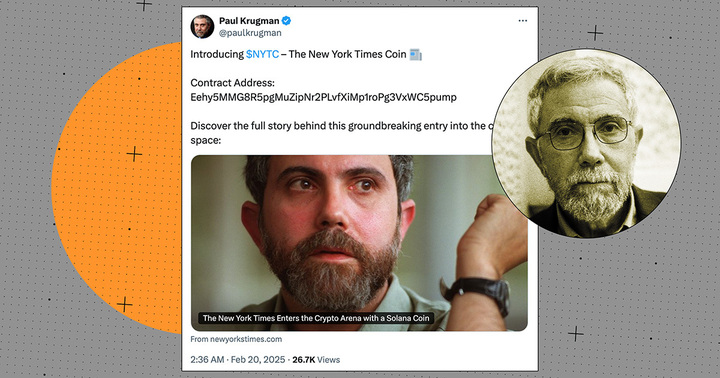
Someone Hacked Paul Krugman’s Twitter and Made an Entire Fake Website for the New York Times to Shill a “New York Times Coin” Scam Coin

Elon Musk Shares Galaxy-Brain Theory About Bitcoin Creator

Dubious Court Case Claims Bitcoin Co-Creator Is Dead

Update: Martin Shkreli Says He Was Hacked, Didn’t Sell Off His New Crypto Token
SEE MORE
More in Blockchain

SBF’s Lawyers Say It’s Fine to Leak Your Ex-Girlfriend’s Diary to the New York Times

A Cache of Ancient Bitcoin, Possibly Mined by Satoshi, Just Awakened

Creator of “Stablecoin” That Crashed to Zero Says It’s Creating a New One

Bitcoin Creator Satoshi Nakomoto Is Now One of the World’s Wealthiest People

The Head of the CIA Says It’s Been Doing Mysterious Cryptocurrency Work

John McAfee Vows to Reveal Bitcoin’s Creator
Shocker: John McAfee Suspends Plan to Unmask Bitcoin’s Creator
Sad! Trump’s Meme Coin Has Turned Into a Total Disaster
SEE MORE
More in Future Society

New York Times Accused of Running AI-Generated Article

We Talked to a Writer Accused of Publishing An AI-Generated Essay in The New York Times

CEO of Palantir Says AI Will Seize Power Away From College-Educated Women

Meta Reportingly Firing a Vast Percentage of Its Staff in Zuckerberg’s Move to AI

China Is Rapidly Overtaking the United States as the World’s Scientific Superpower

Nvidia CEO Says Gamers Are Completely Wrong About His New AI Feature That Yassifies Games

Elon Musk Says He’s Epically Screwed Up at xAI, Is Rebuilding “From the Foundations”

AI Is Forcing Employees to Work Harder Than Ever
SEE MORE
Canonical source
Source domain
futurism.com
Author
Frank Landymore
Publisher
futurism.com
License / usage
Unknown. Review the original source terms before republishing beyond public-safe excerpts.
Overall quality score, confidence 82%
72 sentences, 0 headings, 0 list items.
Add descriptive headings to make the document easier to scan.
Shorten long sentences for public documentation readability.
Related Documentation
Chert | iMessage Infrastructure for Reaching People at Scale
Skip to main content https://docs.platphormnews.com/docs/chert imessage infrastructure for reaching people at scale main content Back to docs https://docs.platphormnews.com/docs Skip to content ↗ https://www.trychert.com
7 min read
SEO Starter Guide: The Basics | Google Search Central | Documentation | Google for Developers
Skip to main content https://developers.google.com/search/docs/fundamentals/seo starter guide main content Google Search Central English Deutsch Español Español – América Latina Français Indonesia Italiano Polski Portugu
22 min read
Chert | iMessage Infrastructure for Reaching People at Scale
Skip to content https://www.trychert.com/ main content New Chert is now live on Hacker News Check it out → https://www.trychert.com/agent Chert https://www.trychert.com/ Home https://www.trychert.com/ Blog https://www.tr
5 min read
Three Inverse Laws of AI - Susam Pal
9 min read
GameStop Proposes to Acquire eBay at $125.00 Per Share | GameStop Corp.
GameStop Corp. (NYSE: GME) today submitted a non-binding proposal to acquire 100% of eBay Inc. (NASDAQ: EBAY) at $125.00 per share in cash and stock. The offer represents a 46% premium to eBay’s unaffected closing price on February 4, 2026, the day GameStop started accumulating its position in eBay. GameStop has built a 5% economic stake in eBay through derivatives and beneficial ownership of common stock. GameStop is filing a Schedule 13D and HSR notification tomorrow. The full proposal letter and accompanying materials are available at investor.gamestop.com/ebay . The proposed offer is $125.00 per share, comprising 50% cash and 50% GameStop common stock, with full shareholder election rights as to consideration type and pro-rata allocation. Aggregate undiluted equity value is approximately $55.5 billion, based on eBay’s most recently disclosed undiluted share count, representing a 27% premium to the 30-day VWAP and a 36% premium to the 90-day VWAP. The transaction is conditioned on
11 min read