The bizarre history of internet outages
In a world where a single point of failure can throw our machines into chaos, everything from sharks to authoritarian governments and old ladies have brought the web to its knees.
The bizarre history of internet outages #
20 October 2025ShareSaveAdd as preferred on Google ↗Thomas Germain
 Getty Images(Credit: Getty Images)In a world where a single point of failure can throw our machines into chaos, everything from sharks to authoritarian governments and old ladies have brought the web to its knees.
It's a reminder of just how fragile the internet services we rely upon can be. On Monday 20 October 2025, millions of users woke to find their favourite apps, gaming sites, online banking and internet tools were not available ↗. The problem is thought to have been caused by an error with a database service provided by Amazon Web Services (AWS), which is the online retailer's cloud computing division.
AWS provides online computing infrastructure for millions of large companies' websites and platforms. The outage affected the hugely popular games ↗ Roblox, Fortnite and Pokémon Go, the social media platform Snapchat, productivity tools Slack and Monday.com, along with dozens of banks.
It is the latest in a number of high-profile outages to have hit the internet recently. As our infrastructure becomes ever more tangled with the internet, this won't be the last catastrophic online outage either. The history of computing is littered with examples of our digital fragility, and crashes of the past offer a glimpse of what it will feel like on the day the internet turns off.
On Friday 19 July, 2024, the world woke up to what many have called the worst digital crisis of all time ↗. A botched software update from cybersecurity giant CrowdStrike crashed some 8.5 million computers, smearing Microsoft's dreaded "blue screen of death" across the globe. Airlines cancelled over 46,000 flights in a single day, according to the FlightAware ↗. Hospitals called off surgeries. 911 emergency services faced disruptions in the US. Film Forum, an arthouse cinema in New York, switched to cash payments as its credit card system went down. Microsoft and CrowdStrike issued a solution ↗, but the disruption it caused continued for several days afterwards ↗. It's a reminder, frustrated IT experts said, to never push updates out on a Friday.
"There's a price to pay for the convenience we enjoy," says Ritesh Kotak, a cybersecurity and technology analyst. "It will happen again, and from a technical standpoint, the fix for CrowdStrike was relatively easy. Next time, we might not be so lucky."
A glitch in the matrix #
One of the earliest major outages came in 1997 thanks to a glitch at the company Network Solutions Inc., one of the main registrars that issues domain names for websites. According to the New York Times ↗, a misconfigured database crashed every single website ending in .com or .net. It took down around one million sites, which at that point in history was a huge portion of the web. Some people didn't get their email. An untold number of web searches ended in frustration. Some businesses who couldn't reach clients and customers lost business around the 1997 crash, but overall, the problems were minimal.
Yet with the internet now touching nearly every part of our daily lives, anything close to the Network Solutions outage has far greater consequences. Twenty-one years later, for example, a malware attack on the Alaskan community of Matanuska-Susitna took an array of digital services offline. The internet blackout sent 100,000 people back in time ↗.
On some level, the internet really is just a series of tubes"The cyber-attack, God help us, just about stopped everything, you know," local Helen Munoz told the BBC in 2019. "In fact, the borough still [hasn't sorted out] their computers."
Employees were locked out of their workstations. Local libraries were ordered to turn off all their devices. In one government office, workers had to switch to typewriters ↗ to do their jobs. It was 10 weeks before the majority of the Matanuska-Susitna's systems came back online.
We're going to need a bigger cable #
Sometimes the problems start in the physical world. For a while, the entire nation of Armenia's internet connectivity depended on a single fibre-optic cable running through Georgia. If that sounds precarious, you're right. In 2011, a 75-year-old woman took all 2.9 million Armenians offline ↗ when she sliced through that cable with a spade near the Georgian village of Ksani. The woman, who was scavenging for copper at the time, was arrested but reportedly let go soon after because of her advanced age. She later told reporters: "I have no idea what the internet is ↗."
 Getty ImagesForget human error: engineers have to take measures to protect undersea cables from shark attacks (Credit: Getty Images)Others felt its absence more keenly. "You can feel it when you don't have access to the internet. You start going crazy," says Vahan Hovsepyan, senior community and public policy advisor at RIPE NCC, the regional internet registry for Europe, the Middle East and Central Asia, who lives in Armenia. "There's no way to ensure stability when you have a cable that's thousands of kilometres long," Hovsepyan says, which highlights the importance of building redundancies into digital infrastructure.
It's proof positive that, on some level, the internet really is just a series of tubes ↗. Pensioners aren't the only threat to those tubes, either. In 2017, all of Zimbabwe ↗ lost its internet access for half a day. Local newspapers reported that a tractor had torn through a cable in South Africa.
The fibre-optic cables in our backyards need protection from human beings, but the thousands of kilometres worth of cables draped across the ocean floor face their own dangers. Sharks have a mysterious fondness ↗ for biting undersea cables, which has caused outages in the past. There's a long history of teeth marks on these ocean cables, not just from sharks but other fish and barracudas. A tooth can penetrate the insulation and mix sea water to ground the power conductors. It's been causing problems for phone and telegraph cables since at least 1964, according to a report ↗ from the United Nations Environment Programme. Today, Google reportedly ↗ wraps its underwater cables in a Kevlar-like material, in part to stop sharks and other ocean dwellers from biting through the internet. Videos posted online have captured the web-hating sharks in action ↗.
Digital fallout #
A quarter of Canada's ↗ internet and phone service was knocked out in 2022 ↗ because of a failure at Rogers Communications, one of the country's biggest telecom providers. It gave 11 million people ↗ a preview of July 2024's CrowdStrike debacle. Emergency services couldn't accept phone calls, hospitals cancelled appointments and businesses across the country couldn't accept debit card transactions. Canadian R&B star the Weeknd was forced to postpone a concert ↗.
Kotak, who lives in Toronto, says the Rogers outage didn't have a major impact on his life, but others weren't so lucky. "A friend of mine literally missed the bar exam," he says. "Her whole family were Rogers customers, and she couldn't get the exact address and room number for the test because she only had it written down in her email."
Legislators can prevent these kinds of problems by mandating safety measures in the technology and telecom industries, Kotak says. But sometimes, governments are responsible for internet shutdowns in the first place.
 AlamySinger the Weeknd had to cancel a concert after a failure at Rogers Communication left 11 million Canadians without phone or Internet service (Credit: Alamy)Disabling the internet is also a go-to method for government censorship, both for authoritarian governments and stable democracies. "It's a pretty massive problem," says Zach Rosson, a data analyst at Access Now, a digital rights advocacy group. "By our definition, there have been over 1,500 internet shutdowns since 2016", by governments, militaries and police forces.
In fact, the CrowdStrike disaster shadowed an example that began the same day. Bangladesh faced near total internet blackout ↗ after a government shutdown in response to violent clashes between protesting students and police. The online cutoff has been accompanied by a curfew and reporters say the lack of internet access makes accurate information harder to come by. At least 150 people ↗ have been killed in the clashes, with some local media putting the figure much higher.
There's a growing push to understand internet access as a human right. "Think about all the things it gives you access to: employment, healthcare, education, communication, business and just understanding the world around you. We've found that internet shutdowns actually impede humanitarian delivery ↗ and prevent the documentation of atrocities," Rosson says.
India is probably the world leader ↗ in using internet shutdowns to quell unrest, but it's a widespread tactic ↗ that's been deployed in at least 83 countries including Iran, Russia, Algeria, Senegal, Tanzania, Cameroon and Venezuela, according to Access Now.
The big one #
In places where the internet connection depends on one fibre-optic cable, it makes for a glaring Achilles heel. After decades of the internet worming its way into every corner of our lives through wires and WiFi connections, you might think there would be more built-in fail-safes to keep the world churning. But largely the opposite is true, according to Casey Oppenheim, chief executive at Disconnect, a cybersecurity company.
"To me this is the real lesson of the CrowdStrike event," Oppenheim says. CrowdStrike holds a massive market share ↗ in its corner of the security business, serving more than half the companies on the Fortune 500 list. "The less diversity you have in any ecosystem, the more vulnerable you become, and there's zero diversity at the top of the internet supply chain. You can pick any core area of the internet and you'll find a very short list of companies in control."
In other words, Oppenheim says, the potential for catastrophic internet failures is yet another consequence of "monopolistic forces" in the tech business. When so much depends on a single company, one wrong move can bring it all tumbling down. "As governments take on antitrust issues, it's something we may want to think about," he says.
More like this:
• The cyber-attack that sent an Alaskan community back in time ↗
[](https://www.bbc.com/future/article/20240724-the-day-the-internet-turned-off)• Google just updated its algorithm. The internet will never be the same ↗
[](https://www.bbc.com/future/article/20240724-the-day-the-internet-turned-off)• Why your internet habits are not as clean as you think ↗
The most famous internet failure in history is one that didn't really happen. Twenty-five years ago, the public went into a frenzy ↗ over the Y2K Bug. Many predicted that the dawn of the new millennium in the year 2000 would come with a global computer failure. Thanks to short-sighted engineers, many computer programmes relied on calendars that used two digits for the year instead of four. That meant 2000 would be indistinguishable from 1900 on New Year's Day. Forecasts about the resulting computer crashes were nothing short of apocalyptic ↗, with stories about failing governments, riots in the streets and total societal collapse. The world was just starting to comprehend the power of the tech industry, and for many, the Y2K bug was as terrifying as it was obscure. Some people stocked up on food, water and weapons.
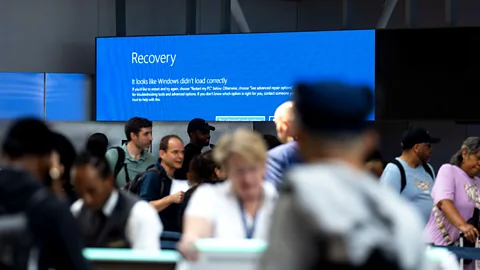 Getty ImagesThe CrowdStrike Internet catastrophe affected millions of people. Experts say it's just the beginning (Credit: Getty Images)There were indeed widespread glitches when the clock struck midnight on 31 December 1999. Most were trivial ↗, such as train delays in Norway or misprinted jury summons ↗ in Oregon, US. Some reports ↗ were serious, but compared to the forecasts, the supposed Y2K disaster ↗ never materialised.
Elevators didn't stop running, as some building managers were reported to fear ↗. Years of warnings about a collapse of the global financial system were for naught. Prison doors did not fling open and let convicts free, despite some warnings ↗. And unlike the early days of the Covid-19 pandemic, the recommended toilet paper stock piles ↗ weren't necessary. The problems could have been far more severe, though the most dramatic prophecies were always overblown.
While the full impact of the AWS outage is still becoming clear, for now CrowdStrike is the closest we've come to a full-blown internet shutdown. Even with its unprecedented scale, however, the consequences lasted just a few days. CrowdStrike was a taste of what's possible. Security experts are still bracing for the big one.
--
For timely, trusted tech news from global correspondents to your inbox, sign up to the Tech Decoded newsletter ↗, while The Essential List ↗ delivers a handpicked selection of features and insights twice a week.
For more science, technology, environment and health stories from the BBC, follow us on Facebook ↗ and X ↗.
Digital ↗History ↗Innovation ↗Internet ↗Technology ↗News Features ↗Watch ## How the transcontinental railroad changed the US forever
In 1869, two companies connected the east to the west with the United States' first transcontinental railroad.
History ## The Finnish shipyard making the world's toughest icebreakers
Tech Now heads to Finland to meet the engineers designing icebreaker ships navigating through Arctic sea ice.
Tech Now ## Lego’s new smart brick
Tech Now experiences Lego's new Smart Brick, designed to bring physical play to next level.
Tech Now ## Fixing fashion's erratic sizing problem
Tech Now meets a startup trying to fix one of the fashion industry's biggest blind spots, inconsistent sizing.
Tech Now ## The tactile tech giving deaf runners a fair start
A gold‑medalist has developed a vibrating starting block to give deaf athletes clearer, fairer race starts.
TechXplore ## These futuristic screens help you navigate Tokyo
In Tokyo, BBC TechXplore tests live translation and AI-powered displays that makes the city more navigable.
TechXplore ## The wearable tech that lets spectators feel the match
At Tokyo's Deaflympics, deaf Judo fans aren't just watching the matches, they're feeling them, thanks to Hapbeat.
TechXplore ## Meet MOFO: will.i.am's rapping AI toy
BBC Tech Now takes us inside CES 2026 to meet musician will.i.am and his AI toy, MOFO.
Tech Now ## The gadgets set to change your daily health and wellness
Tech Now test out new gadgets disrupting the health industry at CES 2026 in Las Vegas.
Tech Now ## What's it like to meet your own avatar?
Musician KT Tunstall meets her avatar as Tech Now explores music’s virtual future.
Tech Now ## Why ancient Roman buildings last for millennia
The ancient concrete made by the Romans is teaching modern construction some new tricks.
History ## How early filmmakers invented the internet’s funniest trend
Discover how quirky clips paved the way for viral humour, proving randomness never goes out of style.
Technology ## AI v The Mind: Meet the world's first artist robot
We find out how AI blurs the line between creation and automation, raising questions about the essence of art.
Innovation ## The secret childhood of Princess Diana
Princess Diana’s cousin shares unseen photos of their private childhood.
BBC Select ## Rare footage of the WW2 Nazi Hindenburg airship crash
This video has expired.
History ## What happened at Hiroshima?
Eighty years ago, the US dropped a nuclear bomb on Japan,the only nuclear weapon ever used in warfare.
History ## Explaining how a touchscreen works with a sausage
British mathematician Hannah Fry digs into the science of touchscreens.
Science ## Why statistics fail to cure flying fears
Why do flying fears persist despite falling accident rates? Learn tips to conquer your anxiety.
Technology ## Pope Joan: the woman who fooled the church
A woman who allegedly was the head of the Catholic Church became one of the most controversial Middle Ages tales.
History ## The secret WW2 magazine ridiculing Hitler's mother
Hiding in an attic, Jewish man Curt Bloch found inspiration through crafting anti-Nazi parody.
HistoryMore from the BBC7 hrs ago ## Why Sam Altman and his former hero Elon Musk are taking their toxic feud to court
The battle between the AI big hitters has largely played out on social media. Now it is coming to the courtroom.
7 hrs ago14 hrs ago ## Hackney disinfecting station at risk, group warns
Campaigners hope England's last remaining disinfecting station in Clapton can be repurposed.
14 hrs ago18 hrs ago ## Historic windmill group starts fundraising campaign
Restored in the late 20th Century, the windmill is Hampshire's only surviving working windmill.
18 hrs ago2 days ago ## The English heiress who stole art for the IRA
Rose Dugdale rejected her privileged background and joined the IRA. In April 1974, reported the BBC, she took part in "one of the largest art heists in history".
2 days ago2 days ago ## Millers can't wait to show off restored windmill
The six-sailed windmill in Lincolnshire is reopening after years of repairs by English Heritage.
2 days ago
Source: www.bbc.com ↗
Source domain
www.bbc.com
Publisher
www.bbc.com
License / usage
Unknown. Review the original source terms before republishing beyond public-safe excerpts.
Overall quality score, confidence 81%
144 sentences, 5 headings, 0 list items.
Use lists for steps, requirements, or extracted facts when appropriate.
Keep source attribution visible in the rendered document.
Related Documentation
Chert | iMessage Infrastructure for Reaching People at Scale
Skip to main content https://docs.platphormnews.com/docs/chert imessage infrastructure for reaching people at scale main content Back to docs https://docs.platphormnews.com/docs Skip to content ↗ https://www.trychert.com
7 min read
SEO Starter Guide: The Basics | Google Search Central | Documentation | Google for Developers
Skip to main content https://developers.google.com/search/docs/fundamentals/seo starter guide main content Google Search Central English Deutsch Español Español – América Latina Français Indonesia Italiano Polski Portugu
22 min read
Chert | iMessage Infrastructure for Reaching People at Scale
Skip to content https://www.trychert.com/ main content New Chert is now live on Hacker News Check it out → https://www.trychert.com/agent Chert https://www.trychert.com/ Home https://www.trychert.com/ Blog https://www.tr
5 min read
Three Inverse Laws of AI - Susam Pal
9 min read
GameStop Proposes to Acquire eBay at $125.00 Per Share | GameStop Corp.
GameStop Corp. (NYSE: GME) today submitted a non-binding proposal to acquire 100% of eBay Inc. (NASDAQ: EBAY) at $125.00 per share in cash and stock. The offer represents a 46% premium to eBay’s unaffected closing price on February 4, 2026, the day GameStop started accumulating its position in eBay. GameStop has built a 5% economic stake in eBay through derivatives and beneficial ownership of common stock. GameStop is filing a Schedule 13D and HSR notification tomorrow. The full proposal letter and accompanying materials are available at investor.gamestop.com/ebay . The proposed offer is $125.00 per share, comprising 50% cash and 50% GameStop common stock, with full shareholder election rights as to consideration type and pro-rata allocation. Aggregate undiluted equity value is approximately $55.5 billion, based on eBay’s most recently disclosed undiluted share count, representing a 27% premium to the 30-day VWAP and a 36% premium to the 90-day VWAP. The transaction is conditioned on
11 min read