Neanderthals ran ‘fat factories’ 125,000 years ago - Leiden University
Fat is a very valuable food component, packed with calories, especially important when other resources might be scarce. Our earliest ancestors in Africa already cracked open bones to extract the fatty marrow from bone cavities. But now a new study published in Science Advances demonstrates that our…

# Neanderthals ran ‘fat factories’ 125,000 years ago
02 July 2025
Fat is a very valuable food component, packed with calories, especially important when other resources might be scarce. Our earliest ancestors in Africa already cracked open bones to extract the fatty marrow from bone cavities. But now a new study published in Science Advances demonstrates that our distant cousins, the Neanderthals, pushed fat extraction from bones quite a bit further.

From complete bones to tiny fragments. Photo: Kindler, LEIZA-Monrepos ## Neanderthal food strategies
The evidence comes from the Neumark-Nord 2 site in central Germany, dating back 125,000 years to an interglacial period when temperatures were similar to those of today. The site was situated in a lake landscape. At this location, researchers found that Neanderthals not only broke bones to extract marrow but also crushed large mammal bones into tens of thousands of fragments to render calorie-rich bone grease through heating them in water. This discovery substantially shifts our understanding of Neanderthal food strategies, pushing the timeline for this kind of complex, labour-intensive resource management back in time tens of thousands of years.
The findings, led by archaeologists from MONREPOS (Leibniz Zentrum Archaeology, Germany) and Leiden University (The Netherlands), in cooperation with the State Office for Heritage Management and Archaeology Saxony-Anhalt (Germany), indicate that Neanderthals operated what can be described as a prehistoric ‘fat factory’, carefully selecting a lakeside location to systematically process bones from at least 172 large mammals, including deer, horses and aurochs. These activities, previously believed to be limited to later human groups, now appear to have been part of Neanderthal behaviour as early as 125,000 years ago.
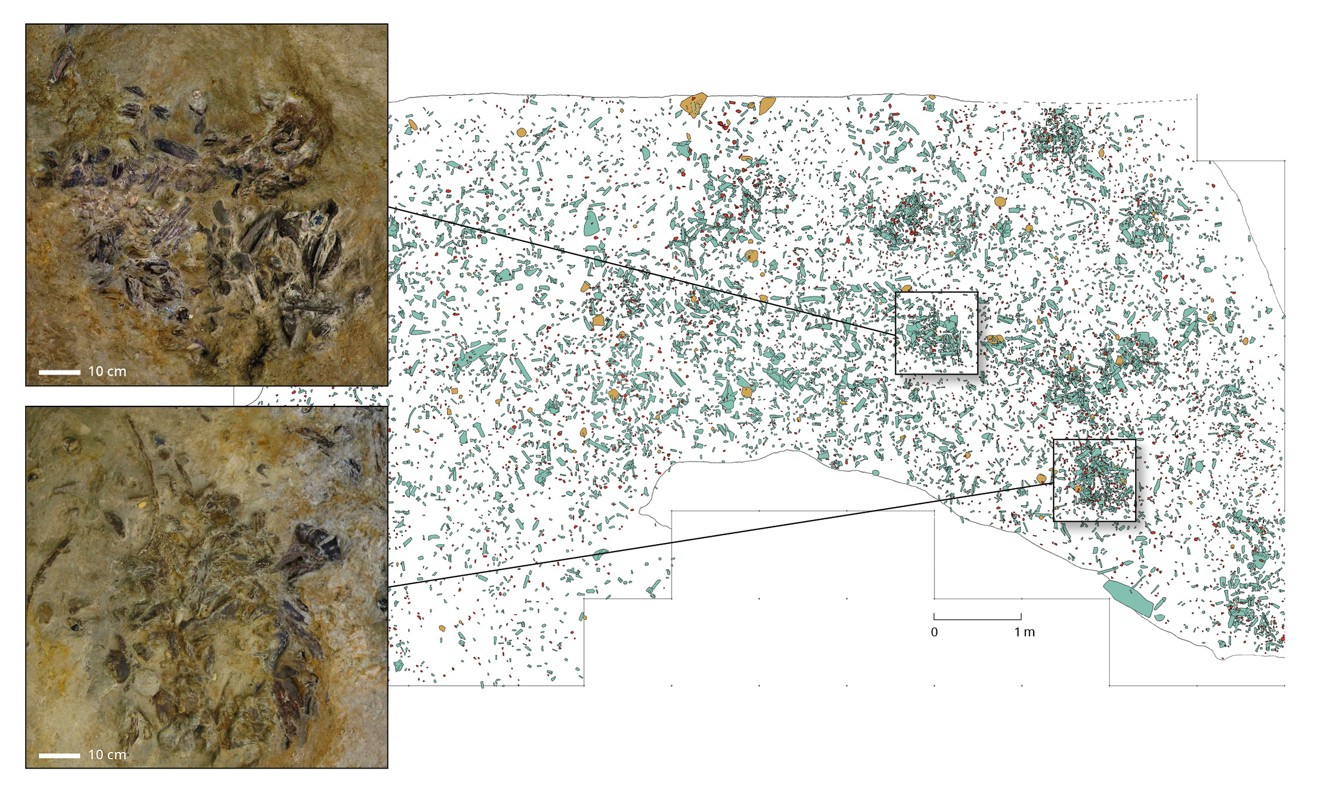
At the Neumark-Nord 2 site, near the margin of a shallow pool, there is a dense concentration of bones from more than 170 larger mammals (highlighted in blue), mixed with flint artifacts (red) and hammer stones (red). Photo: Kindler, LEIZA-Monrepos ## Landscape preservation
This discovery builds on decades of research at the ca. 30 ha large Neumark-Nord site complex already discovered in the 1980s by Jena archaeologist Dietrich Mania. From 2004 to 2009, the Neumark-Nord 2 site was excavated in year-round campaigns by a team led by MONREPOS and Leiden achaeologists ↗. The excavations included a field school, which trained over 175 international students, including dozens of Leiden participants.
In 2023, the team published evidence that Neanderthals hunted and butchered straight-tusked elephants ↗—up to 13-ton animals that could provide over 2,000 adult daily food portions. The use of fire to manage landscape ↗ vegetation and the diversity of processed species at different locations reveal a level of planning and ecological engagement previously underestimated in Neanderthals.
‘What makes Neumark-Nord so exceptional is the preservation of an entire landscape, not just a single site,’ notes Leiden-based author Prof. Wil Roebroeks. ‘We see Neanderthals hunting and minimally butchering deer ↗ in one area, processing elephants intensively in another, and – as this study shows –rendering fat from hundreds of mammal skeletons in a centralised location. There’s even some evidence of plant use, which is rarely preserved. This broad range of behaviours in the same landscape gives us a much richer picture of their culture.’
## Organised and strategic
‘This was intensive, organised, and strategic,’ says Dr. Lutz Kindler, the study’s first author. ‘Neanderthals were clearly managing resources with precision – planning hunts, transporting carcasses and rendering fat in a task-specific area. They understood both the nutritional value of fat and how to access it efficiently – most likely involving caching carcass parts at places in the landscape for later transport to and use at the grease rendering site.’
‘Indeed, bone grease production requires a certain volume of bones to make this labour-intensive processing worthwhile, hence the more bones assembled, the more profitable it becomes’, adds co-author Prof. Sabine Gaudzinski-Windheuser.
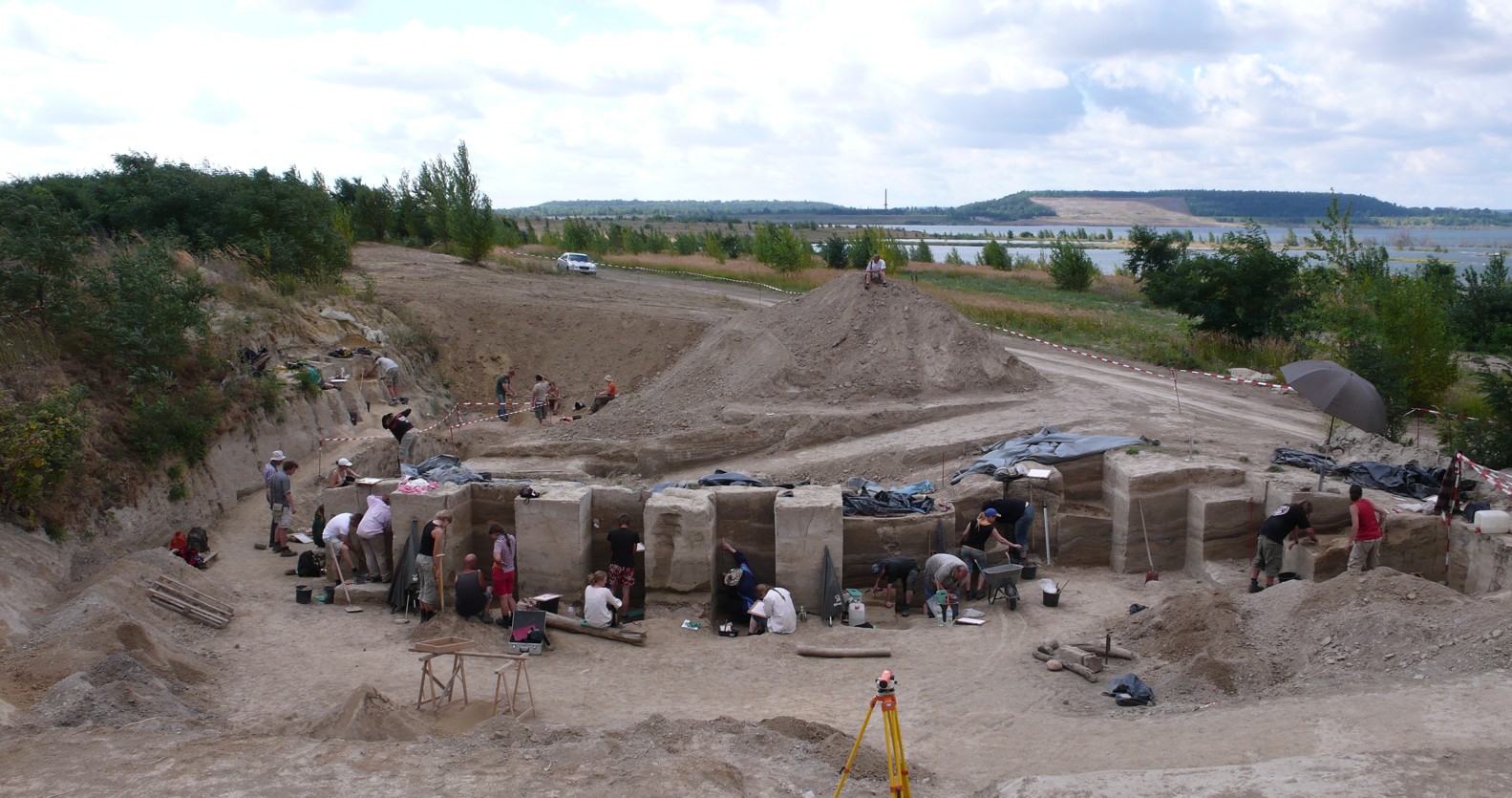
The Neumark-Nord 2/2B site was excavated through year-round campaigns by a core team from 2004 to 2009, alongside an international field school that included more than 175 students in total. Photo: Wil Roebroeks, Leiden University ## Survival strategies
The Neumark-Nord discoveries are continuing to reshape our view of Neanderthal adaptability and survival strategies. They show that Neanderthals could plan ahead, process food efficiently and make sophisticated use of their environment.
The authors emphasise the sheer quantity of herbivores that Neanderthals must have routinely been ‘harvesting’ in this warm-temperate phase: beyond the remains of minimally 172 large mammals processed at that small site alone within a very short period, hundreds of herbivores, including straight-tusked elephants, were butchered around the Neumark-Nord 1 lake in the early Last Interglacial, within the excavated areas only. Other exposures in the wider area around Neumark-Nord have yielded more coarse-grained evidence of regular exploitation of the same range of prey animals, at sites such as Rabutz, Gröbern and Taubach ↗. The last site contained cut-marked remains of 76 rhinos and 40 straight-tusked elephants. Roebroeks: ‘Safely assuming that with these sites we are only looking at the tip of the proverbial ice-berg of Neanderthal impact on herbivore populations, especially on slowly-reproducing taxa, could have been substantial during the Last Interglacial.’
‘The sheer size and extraordinary preservation of the Neumark-Nord site complex gives us a unique chance to study how Neanderthals impacted their environment, both animal and plant life,’ said Dr. Fulco Scherjon, data manager and computer scientist on the project. ‘That’s incredibly rare for a site this old—and it opens exciting new possibilities for future research.’
Read the article in the journal Science Advances ↗.
human evolution ↗ human evolution collective ↗ human origins ↗ neanderthals ↗
Share on Facebook ↗ Share by Bluesky ↗ Share on LinkedIn ↗ Share by WhatsApp Share by Mastodon ↗
## Research
 Fire and Human Evolution
 The Deep History of Human Landscape Manipulation
 Intent on the Paleolithic: Papers in honour of Prof.dr. Wil Roebroeks
 In de ban van de Ararat
 The Earliest Occupation of Europe
 The Middle Palaeolithic Occupation of Europe
 Hunters of the Golden Age
 Guts and Brains
 Studying Human Origins
 Studying Homo erectus Lifestyle and Location (SHeLL)
 What’s in a plant?
 Multidisciplinary studies or the Middle Paleolithic record from Neumark-Nord (Germany)
## Teaching
## Academic staff
 Wil Roebroeks
Professor emeritus
Wil Roebroeks
Professor emeritus
 Eduard Pop
Researcher
Eduard Pop
Researcher
 Fulco Scherjon
Guest researcher
Fulco Scherjon
Guest researcher
## Organisation
Archaeology ↗ World Archaeology ↗ Human Origins ↗
Source: www.universiteitleiden.nl ↗
Canonical source
Original source
https://www.universiteitleiden.nl/en/news/2025/07/neanderthals-ran-fat-factories-125000-years-ago
Source domain
www.universiteitleiden.nl
Author
Unknown
Publisher
www.universiteitleiden.nl
License / usage
Unknown. Review the original source terms before republishing beyond public-safe excerpts.
Overall quality score, confidence 81%
37 sentences, 0 headings, 0 list items.
Add descriptive headings to make the document easier to scan.
Shorten long sentences for public documentation readability.
Related Documentation
Chert | iMessage Infrastructure for Reaching People at Scale
Skip to main content https://docs.platphormnews.com/docs/chert imessage infrastructure for reaching people at scale main content Back to docs https://docs.platphormnews.com/docs Skip to content ↗ https://www.trychert.com
7 min read
SEO Starter Guide: The Basics | Google Search Central | Documentation | Google for Developers
Skip to main content https://developers.google.com/search/docs/fundamentals/seo starter guide main content Google Search Central English Deutsch Español Español – América Latina Français Indonesia Italiano Polski Portugu
22 min read
Chert | iMessage Infrastructure for Reaching People at Scale
Skip to content https://www.trychert.com/ main content New Chert is now live on Hacker News Check it out → https://www.trychert.com/agent Chert https://www.trychert.com/ Home https://www.trychert.com/ Blog https://www.tr
5 min read
Three Inverse Laws of AI - Susam Pal
9 min read
GameStop Proposes to Acquire eBay at $125.00 Per Share | GameStop Corp.
GameStop Corp. (NYSE: GME) today submitted a non-binding proposal to acquire 100% of eBay Inc. (NASDAQ: EBAY) at $125.00 per share in cash and stock. The offer represents a 46% premium to eBay’s unaffected closing price on February 4, 2026, the day GameStop started accumulating its position in eBay. GameStop has built a 5% economic stake in eBay through derivatives and beneficial ownership of common stock. GameStop is filing a Schedule 13D and HSR notification tomorrow. The full proposal letter and accompanying materials are available at investor.gamestop.com/ebay . The proposed offer is $125.00 per share, comprising 50% cash and 50% GameStop common stock, with full shareholder election rights as to consideration type and pro-rata allocation. Aggregate undiluted equity value is approximately $55.5 billion, based on eBay’s most recently disclosed undiluted share count, representing a 27% premium to the 30-day VWAP and a 36% premium to the 90-day VWAP. The transaction is conditioned on
11 min read